Global climate change is one pervasive challenge that must be dealt with by scientists, policy makers, and engaged citizens. Ectotherms, such as fishes, are directly influenced by temperature change. Though most work on climate change and streams and rivers has postulated potential effects of long-term climate change, recent work on stream-dwelling bull trout, provide quantitative determination of habitat change that has already occurred. This article written by Dan Isaak and others in 2009 documented recent increases in stream water temperature of 0.27 C per decade; they further project a 50% decline in bull trout habitat in the next 50 years.
Stream habitat management involve making decisions locally -- decisions that should have benefits far in the future. Margaret Palmer and colleagues reviewed some protection and adaptation options that could be implemented now in "Climate Change and River Ecosystems" published in Environmental Management last year.
Today's agencies (Fish and Wildlife Service) are developing strategies for reducing the future impacts of climate change on climate-sensitive ecosystems. You can expect increasing challenges in applying our knowledge of streams under future uncertain climate conditions. One specific federal initiative is the National Fish Habitat Action Plan. This federal legislation has provided a National perspective and the development of coalitions of government and non-profit organizations to support local efforts in stream habitat management. Take a look at the projects underway throughout the US.
Sunday, August 8, 2010


Tuesday, December 23, 2008
Scientist in the Public Policy Arena

One of the interesting and controversial issues that we did not discuss very much during the past semester was the appropriate role of the scientist in advocating public policy positions. This is a complex issue because the decision is deeply personal; however, there are a range of alternative approaches that you may decide work best for you. At the very least the scientist is obligated to provide scientific information on policy relevant issues when information is requested. For some scientists this is as far as they are willing to go. At another extreme a scientist may evaluate the full range of policy options in light of scientific information and scientific uncertainty -- this is the full time job end of the spectrum. And it is nice if your employer is paying you to do it, but it may be double duty.
The highlighted article was published recently in BioScience. It reflects the reality of advocacy and discusses the roles that professional societies have played. I encourage you to read it as time permits and consider working with and through professional organizations who are often positions to assist in this role.
The position of a 10,000 - person organization will usually take on a more impressive weight than the position of one person.
Happy Holidays.
Monday, December 15, 2008
Portfolio Evaluations

And now the real learning begins. I think 6 people are doing portfolio on a blog, 1 used ePortfolio, and 1 submitted portfolio on a CD.
I will be evaluating the portfolio elements tomorrow starting at 7am. So if you choose to make any changes or check your site to make sure all links are working, you have til morning to finalize. I will contact you if I find any glaring omissions that you must have overlooked or technical difficulties that you can fix before grades are due Saturday.
I will try to keep you informed about Clayter Dam relicensing study reports and public meetings as well as findings related to the Shenandoah River Fish Kills.
However, very soon after the Holiday break I will immerse myself into the blog on Ichthyology
Best wishes and remember to appreciate the wonders of flowing waters.
Happy Holidays!
Thursday, December 4, 2008
Further directions for the ePortfolio set-up
Here is a portion of the email I got from the ePortfolio help desk. They were fairly fast and quite helpful, if you have more questions. This is what I needed to get started, so I thought many of you might appreciate the same information.
Bush Clears the Path for More Mountaintop Removal
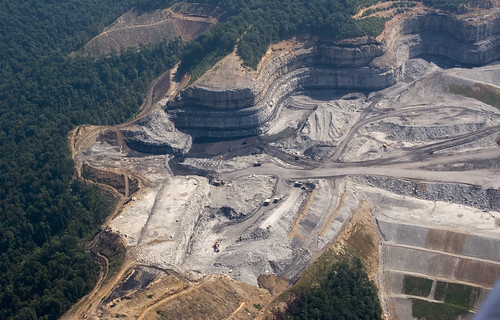
In this administrative ruling clears the way for where to put the mountain tops after they are removed. This clearly violates the intent of the Clean Water Act and is certain to be challenged.
As shown in this photo from Pickering Knob West Virginia, mountaintop removal systematically blasts apart and dismantles entire mountaintops to access multiple seams of coal (top left). The remaining rock is dumped into valleys below (bottom right), burying over 1,000 miles of streams to date. The highly automated process employs far fewer people than traditional underground coal mining.
The effects on surface waters is irreversible. For more information see America's Most Endangered Mountains. Romantics.... gotta love them and their lawyers.
WESTERN STATES WATER
These news items are from the November 14 2008 newsletter of the Wester States Water Council. Highlights the litigation over that important question of "who owns the water"
LITIGATION/WATER RIGHTS
Tarrant Regional Water District v. Sevenoaks, et al.
The 10th Circuit Court of Appeals has ruled that the Tarrant Regional Water District’s lawsuit challenging the constitutionality of Oklahoma’s embargo on out-of-state water sales can continue. Tarrant, a Texas water agency with an application before the Oklahoma Water Resource Board (OWRB), is suing OWRB because it believes that the embargo violates the Commerce and Supremacy Clauses of the U.S. Constitution. In response, OWRB filed a motion to dismiss, claiming that a case in controversy did not exist, that it enjoyed immunity under the 11th Amendment, and that the district court should have abstained from hearing the case. The district court denied the motion and the 10th Circuit confirmed, ruling in Tarrant’s favor on all points.
The Circuit Court found that a case in controversy does exist because the embargo precludes OWRB from granting Tarrant’s application. Similarly, it rejected the OWRB’s claim that it enjoys 11th Amendment immunity because Tarrant’s request to overturn the embargo was a request for prospective relief that would only place Tarrant on the same footing as instate applicants. It also ruled that the denial of the OWRB’s abstention claim was not appealable on an interlocutory basis because the district court’s decision not to abstain “is capable of effective review upon entry of a final judgment in the case.” The 10th Circuit’s decision did not address the merits of the case, which can now resume in the lower federal court.
City of Hugo v. Nichols
In another case, the City of Hugo, Oklahoma, has filed suit in the U.S. District Court for the Eastern District of Oklahoma, claiming that Oklahoma’s embargo on out-of-state water sales infringes on the city’s rights under the Commerce Clause of the U.S. Constitution to sell water interstate. The complaint seeks injunctive relief prohibiting OWRB from enforcing the embargo. Hugo and Irving, Texas entered into a contract in which Hugo agreed to provide Irving with 25,000 acre-feet of water/year for 60 years. In exchange, Irving has contributed $500,000 to help Hugo in its legal challenge, and has agreed to pay Hugo $3.8M while a pipeline from Texas to Oklahoma is designed and built. If the pipeline becomes operational, Irving would pay Hugo $1.7M per year, not including the money it would pay to buy the actual water. This agreement represents the principal difference between the Hugo and Tarrant cases, and is believed to be the first of its kind between an Oklahoma water authority and a Texas customer.
LITIGATION/WATER RIGHTS
Tarrant Regional Water District v. Sevenoaks, et al.
The 10th Circuit Court of Appeals has ruled that the Tarrant Regional Water District’s lawsuit challenging the constitutionality of Oklahoma’s embargo on out-of-state water sales can continue. Tarrant, a Texas water agency with an application before the Oklahoma Water Resource Board (OWRB), is suing OWRB because it believes that the embargo violates the Commerce and Supremacy Clauses of the U.S. Constitution. In response, OWRB filed a motion to dismiss, claiming that a case in controversy did not exist, that it enjoyed immunity under the 11th Amendment, and that the district court should have abstained from hearing the case. The district court denied the motion and the 10th Circuit confirmed, ruling in Tarrant’s favor on all points.
The Circuit Court found that a case in controversy does exist because the embargo precludes OWRB from granting Tarrant’s application. Similarly, it rejected the OWRB’s claim that it enjoys 11th Amendment immunity because Tarrant’s request to overturn the embargo was a request for prospective relief that would only place Tarrant on the same footing as instate applicants. It also ruled that the denial of the OWRB’s abstention claim was not appealable on an interlocutory basis because the district court’s decision not to abstain “is capable of effective review upon entry of a final judgment in the case.” The 10th Circuit’s decision did not address the merits of the case, which can now resume in the lower federal court.
City of Hugo v. Nichols
In another case, the City of Hugo, Oklahoma, has filed suit in the U.S. District Court for the Eastern District of Oklahoma, claiming that Oklahoma’s embargo on out-of-state water sales infringes on the city’s rights under the Commerce Clause of the U.S. Constitution to sell water interstate. The complaint seeks injunctive relief prohibiting OWRB from enforcing the embargo. Hugo and Irving, Texas entered into a contract in which Hugo agreed to provide Irving with 25,000 acre-feet of water/year for 60 years. In exchange, Irving has contributed $500,000 to help Hugo in its legal challenge, and has agreed to pay Hugo $3.8M while a pipeline from Texas to Oklahoma is designed and built. If the pipeline becomes operational, Irving would pay Hugo $1.7M per year, not including the money it would pay to buy the actual water. This agreement represents the principal difference between the Hugo and Tarrant cases, and is believed to be the first of its kind between an Oklahoma water authority and a Texas customer.
Key Principles

Effective stream management extends beyond reach and mesohabitat scales. As humans, we want to fix what we can see. If banks are eroding, we slope them and plant trees. If the Smoky Mountain madtom is extirpated, we reintroduce it. If the dam blows out habitat, we install boulders. However, we must address the cause of the problem. Several papers (Fausch et al. 2002; Allan 2004) stress the importance of viewing stream ecosystems on a landscape scale. In this class, we learned that fixing one problem may not be enough to restore biotic communities. For example, fixing eroded banks in a stream reach downstream of a city, which reaches bankfull stage ten times more often that it should, may not restore the biotic community. As managers, we must make all efforts to restore every aspect of streams that we can. For example, on this stream that drains an urban landscape, bank stabilizaiton may help, but it does not address the cause of the problem.
Subscribe to:
Posts (Atom)
